It is rare to find an item that is capable of bridging several concepts to create a strata of meaning. I stumbled across something of great significance (even if only to me) and would like to share it here at RCompass. I should preface this post by noting that I struggled with writing it. I found it difficult to properly convey the depth of meaning from the collision of concepts that occurred. So if you will bear with me- here is my account of how one small purchase made a lasting impact in my life!
My Purchase
Over the last few years, I toyed with the idea of purchasing a ring for myself. I knew I wanted something of value that resembled me-reflecting my life at least in some small way. About 3 months ago, I stumbled upon a vintage ring online and then again, about a month later. Although I didn’t find the overall style striking, the compass setting definitely caught my eye. However, it was ultimately the allure of the story, connected to this piece, that I found compelling. The seller, InVogue Jewelry, placed a small footnote at the bottom of the picture indicating that she inherited a collection of jewelry from her aunt who was an avid journal-er that spent a significant portion of her life traveling around the world. She would store her found treasures with a description/message about each piece. This particular ring was in a little box with a note that said, “France, Museum Reprod., Real”.
Ellen’s Story
After buying the ring, I contacted the seller and told her a little about my passion for travel and asked if she would be able share any additional information about my purchase. It turns out that Ellen had a remarkable life that spanned ninety years. It was marked by an abrupt separation from biological family and later the loss of her only son; enhanced by a deep love she shared with her husband; steadied with perseverance to move beyond the circumstances unfolding in her life; and enriched through travel. After returning home from a trip to Africa, at the age of 90, she passed quietly in her sleep.
By Design
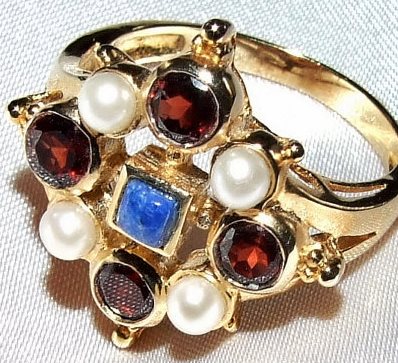
The ring is an early Renaissance inspired, museum replica. It is set in a compass design with four, bezel set, garnet stones and four cultured pearls. At the center, is a small, square cut lapis stone. I associate this ring to paintings created in this time period which were often infused with hidden stories, captured subtly in the design. I can’t help but think of how much thought may have gone into the design of this piece? I can only speculate why Ellen may have been drawn to this particular ring. But, if I take aspects of Ellen’s story-it made me wonder if she also connected to (or believed in) the meaning and properties of the stones used?
- Garnet signifies discovery and protection
- Pearls represent transformation and innocence
- Lapis is said to promote clarity and truth
A special note: In her home, Ellen installed a compass, thoughtfully in-laid in the tile of her foyer visible as she passed through the front door, returning “home” from her travels.
Our Connections
When I began developing this blog, I wrote the content for the page titled, RStory stating that,
“This blog is a nod to the compass (or rose compass) in its truest and simplest form. Steeped in tradition, it is a tool that has been in existence for centuries, an aid, to find position and direction. This can be seen both in the physical world, and for me, a compass also is a symbol, an essence of how people may look for direction and purpose in life.”
I have come to recognize that sometimes it takes time to uncover a serendipitous meaning and to see beyond the obvious facade. To my surprise, I had come to realize that the stones also had significance to me. After experiencing a series of life altering events, I began my Master’s in Tourism and Geography which I attribute to a major shift in my life’s direction (school colors red garnet). My driving force is my family-specifically my son (his birthstone is the pearl). The lapis is linked to my zodiac sign (Sagittarius) which reaffirms the core (center) of my identity and, of course the compass which I refer to as my personal amulet and/or talisman. I also studied French for several years. And have a deep seeded interest in museums exhibiting historical art.
Yes, it is enough to just admire something “pretty” and want to possess or own it. And, yet if we can derive something more, I believe those are the treasures ultimately worth collecting. As they say, beauty is in the eye of the beholder. This story reminds me that even inanimate objects can have a life all their own that resides in the experiences of the people who collect and display them. Perhaps this story was relevant only when filtered through my eyes and personal journey? I keep a copy of Ellen’s story with the ring. And I will proudly wear it for many years. When the time comes, I know that it will find another world traveler to keep it safe….and it’s story will continue.
I would like to thank Dawn, InVogue Jewelry, for sharing Ellen’s incredible story which allowed me the unique opportunity to connect at a deeper, more meaningful level. Here is a link if you would like to visit her shop on Etsy.
 Ancient Egyptian, Greek and Roman eras note the use of garnets in the jewelry. It was said that courageous discoverers and travelers wore Garnets for protection, as they were considered popular talismans and protective stones. It was believed in those days that Garnets illuminate the night and kept the wearer safe (www.gemstone.com).
Lapis Lazuli is a powerful stone for those who seek spiritual development. It brings mental clarity & emotional healing, and enhances judgment and wisdom. This stone is also considered strengthening to mind and body. Lapis lazuli allows us to tap our own inner power while purifying the soul and the thoughts. Helps us contact our spirit guardians. Augments strength, vitality, virility, mental clarity, illumination. Enhances psychic abilities and communication with higher self and spirit guide (http://www.sobrietystones.com).
Pearls symbolize Purity, Spiritual Transformation, Charity, Honesty, Wisdom and Integrity, all the best within us. Pearls provide a clear vehicle for the advancing states of wisdom, as well as a clean channel for receipt of spiritual guidance. Pearls can stimulate femininity and help with self-acceptance. They remind us to walk with dignity, providing a mirror in which to see ourselves and give us insight into how we appear to others. The ragged, rough grain of sand, transformed over time slowly growing into an object of great value and beauty. With it’s humble beginnings, Pearls symbolize innocence and a pure heart, and help us get in touch with the simple honest things of life (http://www.sobrietystones.com).

 Project for Public Spaces (PPS) is a nonprofit planning, design and educational organization dedicated to helping people create and sustain public spaces that build stronger communities.
  RCompass